The wheelwrights apprent.., p.1
The Wheelwright's Apprentice, page 1
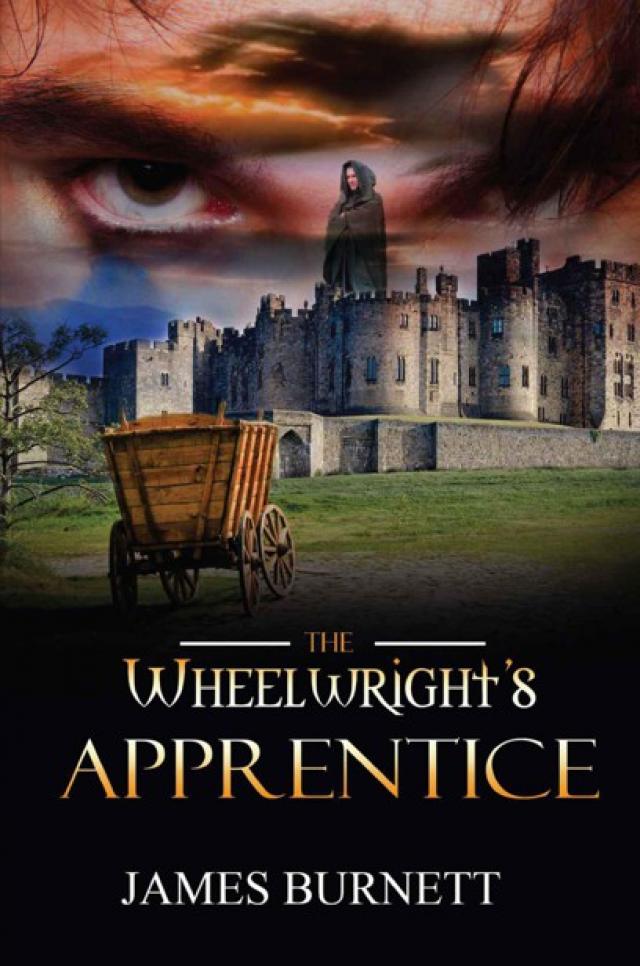


The Wheelwright’s
Apprentice
By
James Burnett
ʀ
A Bright Pen Book
Text Copyright © James Burnett 2013
Cover design by Audra Martin ©
All rights reserved. No part of this publication may be reproduced, stored in a retrieval system, or transmitted in any form or by any means, electronic, mechanical, photocopy, recording or otherwise, without prior written permission of the copyright owner. Nor can it be circulated in any form of binding or cover other than that in which it is published and without similar condition including this condition being imposed on a subsequent purchaser.
Authors OnLine Ltd
19 The Cinques
Gamlingay, Sandy
Bedfordshire SG19 3NU
England
This book is also available in paperback
ISBN 978-0-7552-1546-1
details of which are available at www.authorsonline.co.uk
ʀ
About the Author
Educated at Gordonstoun school in Scotland, James chose a career in casinos, and has spent almost forty years working in the casino which is now part of the Atlantis complex in The Bahamas. He started by writing casino stories, and is now working on three other SF/Fantasy books. Married with two teenage daughters, he plays squash, cycles, and reads a lot.
ʀ
Dedication
I want to take this opportunity to remember certain family members, who were writers, but for various reasons had rather limited success. The first was my Australian grandmother, Werna Mary Brown, later Gordon-Brown. Unsurprisingly she preferred to be known as ‘Queenie’. A journalist, she wrote a novel which the publishers in Melbourne advised her to take to London as they felt it was quite good, and would do better there. Taking their advice, she embarked on a liner to London called the Pericles, which promptly sank. She survived, but the book didn’t. In those days – it was 1908 or 9 - one manuscript was it.
My father, Robert Burnett, went one better. He wrote a biography of Gauguin, which was published in 1939. It was quite well received, and was translated into French and German. The overseas royalties, for some inexplicable reason, never materialized. After the war, he tried to do thftee bio on another artist, but someone else published one on the same man while his manuscript was in progress. This, on top of his very stressful wartime experiences as a polyglot interrogator, knocked the stuffing out of him.
My mother, also Werna Mary, (she chose Mary!) wrote anonymous stories for the magazine The Tatler while my dad was struggling, but never told him. I believe he thought her to simply be thrifty with the housekeeping budget.
Her cousin, and my godfather, John Marriner wrote stories for yachting magazines, which he collected into book form, and followed with other travel books about yachting. Even though he wrote for a relatively limited market, he was the most successful. Of course he was the only one who didn’t need the money.
All these family members showed me that it was possible to write a book, and I thank them for showing me the way.
Contents
1
2
3
4
5
6
7
8
9
10
11
12
13
14
15
16
17
18
19
20
21
22
23
24
25
26
27
28
29
30" width="
31
32
33
34
35
36
37
38
39
40
41
42
43
44
45
46
47
48
49
50
51
52
53
54
55
56
57
58 Epilogue
ʀ
1
The arrow hit the wall behind him with a solid thunk, and quivered slightly. It had come through one of the many cracks and holes in the outhouse. If he hadn’t been bending down to pull up his pants, the arrow would have caught him right in the chest. After a short moment, which seemed to him very drawn out, reality punched him in the gut. His mind swirled and pitched, then settled. If someone was shooting arrows around, something was obviously very wrong.
He quickly looked through another of the cracks, and saw several mounted men. They were raiding the village, his village, where he had spent all of his fifteen years, and they were killing everyone. He saw old Don the baker run at one with a scythe, only to be stopped well short of his target by a well placed arrow in the throat. He was not the only one. He looked out of other holes and he saw a couple of other corpses, one obviously his mother. He couldn’t see her face but he knew her clothes well enough to recognize her. He knew she was dead as her head was laying a couple of fegh heset away, connected to her body by a pool of blood.
He could see over a dozen raiders, and knew that there had to be more. They were a fearsome bunch. They carried swords, spears and bows. He saw one trample old mother blacksmith’s henhouse, and another lazily ride up behind big Dem, the innkeeper’s son, and simply behead him with an easy stroke as he passed. Their collection of horned helms seemed unnecessary, if they were only to instill fear. Their actions were more than enough.
The world flipped upside down, and he collapsed back on the seat. He had never known the emotions that were converging on him all at once. He felt fear, sorrow, terror, despair and a burning need to be somewhere else, any somewhere else, and he didn’t even know if he had the willpower left to stand. He sat there for what for him felt like forever but in reality was only a few seconds. “What do I do?” His mind wailed inside his head. “What can I do?” A more logical part of his brain supplied. At last, instinct kicked in, and he realized, “I have to move, and I have to move fast.” He looked out through a crack and thought, “Is there anywhere close that I can go to and be safe?” He simply had to get as far away as he could as quickly as possible.
The sounds of the raiders now started to impinge. There were the horses with their hoof beats and their neighing. There was shouting, both from raiders and villagers. There were squeals from the livestock, and the wailing and the struggling of the few pretty girls, as they were grabbed as booty.
He had no brothers or sisters to worry about. In fact the only person who mattered to him was already lying dead just yards away. He was alone. He was now reliant only on himself, and all that self reliant brain told him was to run fast and run far. As soon as he left the concealment of the outhouse he would be seen, and he could not afford to just hide where he was. The band of raiders was plainly large, and he would be found in the end. He would have to choose his moment to make a run for it. But when?
Without opening the door, he unlatched it. He peeked again and still saw plenty of mounted men. He was sure they would come and look in the outhouse at any moment. There was no chance that they could ignore it. Should he run now while there was still plenty of confusion and hope to be ignored? Where was the nearest cover?
There was a copse of trees down by the millpond, but apart from the buildings which were now mostly burning, that was it. He would have to be missed by the raiders who were undoubtedly helping themselves to all the flour in the millhouse. “Please! Please!” He wished with all his heart, as if his life depended on it, which of course it did. “Let them not see me while I rush for cover.” Inch by inch he slowly eased the door open.
The moment came not by logic or luck, it was chosen by a burst of terror which impelled him into rapid motion. Before he realized it, he was sprinting across the commons towards the millpond. Such was the fear that chased him that he couldn’t swerve from his path even when a raider appeared almost in front of him. All he could do besides run was keep repeating the mantra to himself, “Please don’t let them see me!” and surprisingly, it appeared that they didn’t. He ran past one raider who ignored him, and then a further group who seemed to look right through him. He didn’t question fate, but kept running. The copse loomed big, and he dashed id t he dasnto it, collapsing behind an elm tree. “How was it that I made it this far?” he asked himself, while his chest heaved like a bellows and cold sweat made his shirt stick to his back. “I still need to move, but where next?” That was the question. No answer came so he burrowed a little further in and waited for his brain to start working again.
In a little while, he saw two choices: move or stay. Would they leave or would they stay? What would the raiders do if they stayed? What should he do? For a while all he could think was, “Please don’t let them come this way.”
He woke cold, damp and miserable, but alive. Somehow he must have slept. It was dark with enough moonlight to see. There were no sounds coming from anywhere except for an occasional crackle. It was the sound of the embers of a house that had burned. He couldn’t tell which one, but, as he was cold he was drawn there. Carefully he got up, and moved towards it as quietly as he could. He still saw no one. Nobody appeared to be near, nobody living anyway. He quickly looked around for the c orpses he had seen earlier, but they had been moved. It wasn’t that he didn’t want to find his mother; it was that he didn’t want to see her dead up close. He wanted his last memories of her to be live ones, so he just sat in what was left of the warmth, and let his mind become numb as his body returned to normal.
Eventually he allowed memories of his mother to swirl around. Riffling through this personal legacy, one memory itched as it surfaced, “Who was my father, and does he ever come around here?” he remembered asking his mother one evening, as he was cleaning up after supper.
She had sat down in her usual chair, and said, “To be honest I don’t know who he is, as I don’t think he gave me his true name, but he is an important man, and a very handsome one. I used to see him six or seven times a year for about a year and a half. I looked forward to his visits. He brought me nice presents, and was always very good to me. The last time he visited was when I told him I was pregnant with you. He was very happy that time, and also a little sad. That was when he told me, “When he is old enough, send him to me. I always spend fifth month in the mountains. I have a place between Horseford and Midpass. He won’t be able to miss it. You need to remember that!” his mother had made sure he recalled it as well, and he had.
Now sitting close to the dying embers, he thought, “Well I suppose I have somewhere to aim for, but I am not even sure where Horseford is, and I think it is almost fifth month already.” He waited numbly for dawn and the light of the sun, first tracing the lines between the flagstones on the floor in the flickering firelight, and then again as day slowly encroached on the night. As soon as he could see well enough, he got up, and moved around looking for what had been left. He knew he couldn’t stay, as everyone else was dead. He also knew that he would need money and supplies if he were to travel. He went to see what could be scavenged from the ruins of the village.
Four hours later the sun was high, and it was getting hot. He hadn’t found much of value left in the village. He had found the corpses all piled together, stripped of everything. It looked like pretty much everyone from the village, although he couldn’t bear to look inside the pile. He didn’t really have the nerve to touch them anyway. He had inventoried his sack. Two threadbare blankets, three silver and four copper coins from Rom Butcher’s stash which his dead friend Gim Butcher had told him about, a flask that one of the raiders must haButders muve flung aside that he had washed out several times to remove the taint of spirits, and a knife he had found on the ground. He had not speculated as to how it had got there.
He was very depressed. He was also very angry, but he had not let his anger out until now. As he first put one foot in front of the other, he felt his anger rise slowly, growing with each step. With his face turned to the nearest village, Joman’s Crossing, some fifteen miles away, he vowed that he would somehow make the raiders suffer, sometime, for what they had done, but he had no idea how.
ʀ
2
Three hours, and six miles later, he was tired and hungry. He had been to Joman’s Crossing only once before with the wheelwright to whom he had been apprenticed. Travelling in a cart had seemed uncomfortable and bumpy at the time, but it was infinitely better than slogging it along the rough track on shank’s pony. He knew that there were a couple of farmsteads on the way, but no more, as this close to the border people stayed together for protection. It hadn’t done his village much good, and he hoped that the farms might be able to spare him something, as long as they still existed. The first one should, if his memory served, be very near, and a short time later he saw a thin swirl of smoke in the distance.
Was it from a fire in a fireplace, or was it from a burning building? He stepped away from the track, and carefully made his way closer. Cresting a small rise he could see the farmhouse still standing, and for the first time in a long while he felt his spirits lifting. As he drew closer to the house, he saw the farmer and his two sons come out carrying scythes and cudgels. When he was near enough for them to make out his features, they relaxed and hailed him.
“Are you Kan Wheelwright’s apprentice?”
He nodded assent, and replied, “I am glad you are alive, because no one else from my village is!”
After having told the story of his day, and what he could remember of the night to the farmer, his goodwife and children, he could see only grim expressions. Apparently a riderless horse had passed by earlier, but they had been unable to catch it. They had been worried, and now their worst fears were realized. With a loaf of bread and a nub of cheese for which he had insisted on paying, he hurried on so that he could make Joman’s Crossing before dark.
He tried to make the best time that he could, and although he saw one other farmstead along the way, he chose to pass it by. He really did want to get to Joman’s Crossing before dark, not just to pass on his news to a responsible person, but because, whatever the cost, he wanted a safe, snug night in a bed to help him recover from the shocks that he had not yet properly faced.
It was still twilight as he limped into the market place in Joman’s Crossing. Priorities crossed his mind. Should he look for a room or for the Constable? He knew if it was the room first, he would collapse until midday tomorrow, so reluctantly he trudged to the Constable’s house. The Constable was a young man with a young wife and baby. He was also very kind and professional. He started to listen carefully and then stopped him, saying, “You need to eat, and then we’ll start again and take notes. You have had a great shock and need to relax.”
The Constable’s wife placed a platter in front of him, and he was unable to talk until he had finished it. Afterwards it turned out that he had a very meticuloupanIs memory. The Constable was writing every little detail, from the design of the helms to the breed of their horses, the styles of sword and bow, and things that seemed inconsequential to him like the fletching on the arrows. Between swallows of water, as his mouth was dry, he managed to impart everything he had seen. By the time he had finished, his head was on the kitchen table, and he was snoring.
He woke up the next morning on a pallet in the kitchen when the goodwife came in to start cooking breakfast for her family.
“Good morning,” he greeted her, “I guess I just collapsed on you.”
“I am not surprised that you did with the day you had,” she replied, “Did you sleep well?”
“I must have done, as my last memory is sitting at your table with your husband busily writing. Please can you point me towards the jakes?”
He walked to the outhouse, and while there recalled that for him, an outhouse was where it had all started for him. He then drew some water from the well, and washed his hands and face before taking a long cool draught from a second full bucket. He then poured the remainder into the bucket left there for carrying water inside, and brought it in with him.
Once inside, he saw the Constable was up, and greeted him with a cheery, “Good Morning.” He then asked the question he had been avoiding, “What are you going to do now?” Reality descended with a crash that was somewhat softened by the admonition, “Have some breakfast first before you answer!”
Sitting back a few minutes later under the watchful eye of the Constable, and feeling a lot better, he at last managed a smile. He told the Constable, “My mother told me that when I was old enough she would send me to my father. She didn’t know his name, but said that every year during fifth month he would be at a place between Horseford and Midpass, and that I couldn’t miss it!” The Constable let out a huge belly laugh.