

Upended, p.1
Upended, page 1
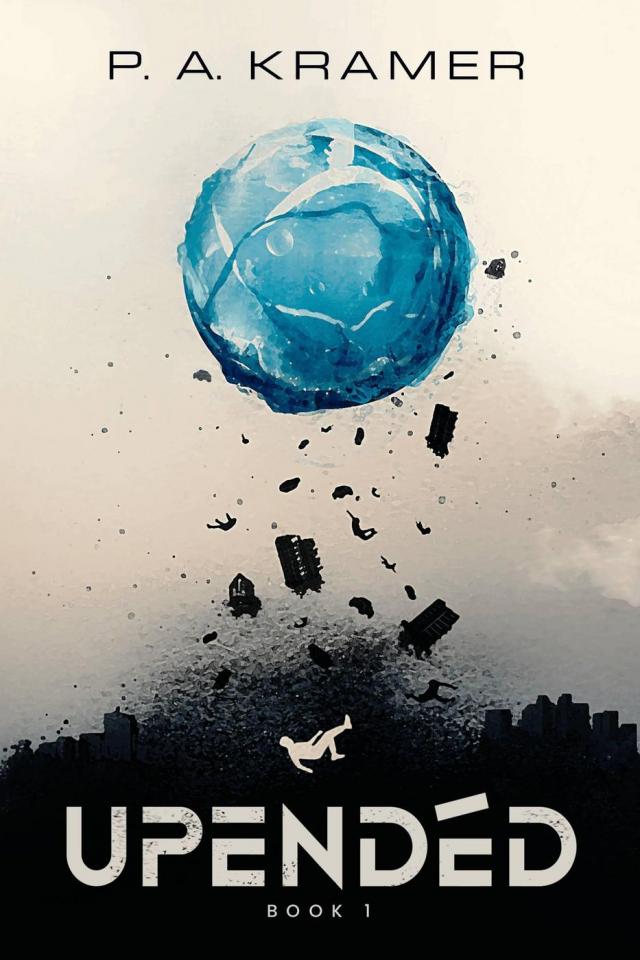


P. A. KRAMER
Upended
Copyright © 2026 by P. A. Kramer
First edition
All rights reserved. No part of this publication may be reproduced, stored or transmitted in any form or by any means, electronic, mechanical, photocopying, recording, scanning, or otherwise without written permission from the publisher. It is illegal to copy this book, post it to a website, or distribute it by any other means without permission.
This novel is entirely a work of fiction. The names, characters and incidents portrayed in it are the work of the author’s imagination. Any resemblance to actual persons, living or dead, events or localities is entirely coincidental.
This novel was written in its entirety by the author. No generative AI was used in the story’s conception, development, writing, editing, or cover art.
Editor: Dylan Garity
Cover artist: Elementi.studio
Table of Contents
Title Page
Copyright Page
Dedication
AUTHOR’S NOTE
PROLOGUE
CHAPTER ONE
CHAPTER TWO
CHAPTER THREE
CHAPTER FOUR
CHAPTER FIVE
CHAPTER SIX
CHAPTER SEVEN
CHAPTER EIGHT
CHAPTER NINE
CHAPTER TEN
CHAPTER ELEVEN
CHAPTER TWELVE
CHAPTER THIRTEEN
CHAPTER FOURTEEN
CHAPTER FIFTEEN
CHAPTER SIXTEEN
CHAPTER SEVENTEEN
CHAPTER EIGHTEEN
CHAPTER NINETEEN
CHAPTER TWENTY
CHAPTER TWENTY-ONE
CHAPTER TWENTY-TWO
CHAPTER TWENTY-THREE
CHAPTER TWENTY-FOUR
CHAPTER TWENTY-FIVE
CHAPTER TWENTY-SIX
CHAPTER TWENTY-SEVEN
CHAPTER TWENTY-EIGHT
CHAPTER TWENTY-NINE
CHAPTER THIRTY
CHAPTER THIRTY-ONE
CHAPTER THIRTY-TWO
CHAPTER THIRTY-THREE
CHAPTER THIRTY-FOUR
CHAPTER THIRTY-FIVE
CHAPTER THIRTY-SIX
CHAPTER THIRTY-SEVEN
CHAPTER THIRTY-EIGHT
CHAPTER THIRTY-NINE
CHAPTER FORTY
CHAPTER FORTY-ONE
CHAPTER FORTY-TWO
CHAPTER FORTY-THREE
ABOUT THE AUTHOR
To the scientists who fight for truth,
who follow the evidence,
who avoid any bias,
and who never stop learning.
AUTHOR’S NOTE
If there was one thing I could instill into the public consciousness, it would be the definition of a scientific theory. They are not “just guesses.” They are the most rigorous of scientific explanations and models. They are internally consistent, follow established laws, have predictive power, and are backed by mountains of evidence.
That said, the theory of gravity depicted in this novel meets none of these criteria. In my attempt to scientifically rationalize the inciting incident of this novel, I spent many hours poring over theories of gravity. But in the end, I could not reasonably justify an event that could negate matter’s gravitational attraction. And the last thing I want is to give it the illusion of scientific legitimacy. I do categorize this as hard science fiction, after all. Inserting this ‘soft’ science into a novel that was otherwise full of accurate science (assuming I did my job right) would only feed misconceptions about gravity.
So instead, I invite the reader to treat this novel as a what-if scenario. How would objects and people react to the permanent loss of gravity? How would this unlikely discovery be used to benefit humanity... or destroy it?
PROLOGUE
Dylan was minutes away from losing a bet.
Risking a glance at the mirror behind the bar, he was surprised to see his smile hadn’t wavered. Any casual observer would see two people in conversation, one listening attentively as the other drew on the back of a napkin. That same observer might even mistake the torment in the man’s eyes for longing... until they overheard the conversation.
“. . . because you see,” the girl said as she added a few more lines of blue ink to the pattern on the napkin, “the cells can’t form their apical and basal polarization without significant points of contact. That’s not a problem with our synthetic matrices. The fibers facilitate firm adhesion, allowing the cells to polarize into a nephron’s proximal convoluted tubules.”
She glanced up through the bangs of her short black hair, and Dylan tightened his smile.
“Convoluted indeed,” he said with a chuckle.
She smirked and lowered her eyes again.
“I’m sorry. You asked what I did for a living, and here I am laying out my entire graduate thesis. I guess I never worked out an easy way to explain it.”
“I could listen to you talk for hours,” he said, causing her sepia-toned skin to deepen a shade. “Seriously, I’ve learned a lot.”
He wasn’t lying either; he had learned a lot. He’d learned never to strike up a conversation with a girl wearing a purse stuffed with pens, highlighters, and printed research articles. For a reason he still couldn’t fathom, he had singled her out over all the other girls at the bar. It was too soon to tell how much that mistake had cost him.
She laid down her pen and spent the next few seconds positioning it perfectly parallel to the napkin and perpendicular to the edge of the bar.
Resisting the urge to grab the pen and throw it across the room, Dylan took out his phone. He glanced at the screen and abruptly stood from his stool.
“I need to throw some change in the parking meter. You’ll still be here when I get back, right?”
He took a step back and held his hands up as if to frame her in a picture.
She dipped her chin in a nod.
Dylan started to take another step, then reversed his direction, startling her with his sudden return.
“No, I’m sorry, I can’t risk it. Some other guy will come flirt with you the moment I walk away. Give me your number. That way I can call you if it looks like he’s bothering you.”
Placing his hand over the pen and napkin, he slid them closer to her.
Grinning, she took up her pen once more. He was happy to see that she included her name along with the number, a detail he’d already forgotten.
“Don’t you move, Stacy,” he said. He pocketed the napkin and backed away with exaggerated reluctance.
She failed to cover her smile with her hand as she watched him leave.
The instant his back was to her, he rolled his eyes. He thought that would never end. After weaving through a cluster of patrons by the back door, Dylan made straight for his beer on the nearest patio table.
“He made it,” exclaimed one of the two men waiting for him. Ryan slapped him on the shoulder.
Beside him, Fred glanced at his watch. “Ten minutes and thirty-five seconds.”
“Don’t stop the timer yet. We need to see proof.”
Dylan fished the napkin out of his pocket, then proceeded to gulp down his beer.
“Stacy, huh? Wha—What is this?” Ryan asked, turning the napkin over to display a series of diagrams.
Dylan came up for air. “Kill me now.”
“Seriously, what is this?” he repeated.
Fred took the napkin and turned it upside down and then right-side up. “These are the coordinates to star system Nebulon-23e,” he said. He placed it face down on the table as if that settled the matter.
“That would explain a lot,” Dylan said and let out a belch. “But I don’t think she’s an alien. She’s some kind of scientist. Fancy degree and everything. Wouldn’t shut up about it.”
“What’s a nerd like her doing here?” Ryan asked.
“Nerds like alcohol too,” said Fred, the only one of them holding a college degree.
“She said she meets her boss here on Tuesday nights.”
“Sounds scandalous,” Ryan said with a wiggle of his eyebrows.
“Nothing like that. I don’t think. They have something called a journal club. It’s just my luck he’s running late. Who’s going next?”
“What’s the time again?” Ryan asked.
“Ten minutes and thirty-five seconds,” Fred supplied.
“Hope you brought your wallet, Dill, ’cause you’re about to buy our drinks.”
“I want to go next,” Fred said, motioning for Ryan to stay put. “I think I saw a winner.”
“The girl who just walked past?” Ryan asked, lifting his chin toward the doorway. “I saw her first. I have the better angle.”
Fred leaned over toward Ryan, confirming his friend had the better vantage point.
“Flip you for her?”
Ryan sighed, and they fished out their wallets.
Dylan leaned back against the patio railing as his two friends searched for a coin. He picked up the napkin again and looked at the name and number written in the near-perfect script.
If it was the only number he’d get that night, he might decide to call after all. So what if she was the talkative type? She would be nice to look at as he pretended to listen.
“Alright, your call,” Fred said, positioning a quarter on the flat of his thumb and forefinger.
Ryan dutifully called out tails just as Fred flipped the coin into the air.
Dylan craned his neck to watch it fly.
His eyes
“How the—” Ryan began, the words dying in his throat as the quarter continued skyward, failing to fall back to Earth as had every coin in the history of coin tosses. In seconds, it became a flickering silver speck against the dusk-orange sky.
Dylan felt dizzy. And it wasn’t the typical world-spinning, piss-drunk dizzy either. This was something else. His ears popped.
Silence fell over the patio a moment later, the patrons of the bar responding to the unknown and unsettling change in the air.
“I think I’ve had too much to drink,” Fred said into the quiet.
Dylan reached out to steady himself against the table, but it was no longer there. Looking down, he was surprised to find the table a few inches shorter than it had been a moment ago. Everything was shorter, including the railing he had been leaning against. A second later, he realized the truth. Nothing was shrinking. He was hovering several inches off the wooden floorboards.
Dylan shook his head, but the illusion persisted. And he wasn’t the only one levitating.
As soon as the silence had come, it was gone. One by one, the bar’s patrons let out startled exclamations and scrambled for something to hold onto. Then, as if nature itself objected to the new state of things, the ground rumbled, rusting the leaves of trees and rattling dishware inside.
Coming out of his daze, Dylan flailed his arms and legs, trying to catch hold of something. His fingers grazed the top of the table, but the contact only pushed him farther into the air.
“Guys? Guys! Help!”
“Dill,” Fred said in a frantic voice. His friend held the wooden railing with one hand and reached out with his other.
Dylan tried to grab it but fell a few inches short.
“Ryan. Grab him,” Fred said, but Ryan could only stare up, wide-eyed and helpless, from where he clung to a table.
With no other options, Dylan reached for a tree branch extending over the patio, but the bough swayed so violently, he felt only the lashing of leaves against his palm.
It wasn’t until he’d cleared the roof of the bar that he really began to fear for his life. If he fell now, he could break his legs.
He wasn’t alone. A small group of patrons near the front doors of the establishment rose above the roof and into view. Without anything else to hold onto, they clung frantically to each other. One member of the group, a bearded man with a plaid shirt, pushed off from the others in a desperate attempt to reach the eaves of the roof. His gamble was successful, but the others paid the price, flying up and back in the opposite direction.
The anomaly was not limited to people. Cars traveling down the road on the far side of the bar lost contact with the asphalt and plowed into one another, unable to brake. Once their momentum was spent, they too lifted skyward.
A cool wind swept in then, whipping leaves, dirt, and small rocks into a maelstrom. Grains of sand stung Dylan’s skin and eyes as the breeze tugged him even higher, out above the trees.
As he neared the edge of Lake Sammamish, hope welled in his chest. If he could only get above the water, it might break his fall.
With a sinking feeling, he watched the entire northern side of the lake balloon out like a sail caught in the wind. The bulge of water rose up and circularized, turning what had once been still water into a massive undulating sphere. Docks and boats tore free of their moorage to join it. One sailboat, its crew clinging to its mast and lines, stayed afloat on the surface of the sphere for just a few moments before the water rose up around it, dragging it under.
Everything continued upward without any sign of stopping.
Even as he watched, mouth slack and eyes tearing, Dylan knew it wouldn’t be much longer before death came for him too. He didn’t know what would kill him, precisely, but if nothing changed, he might ascend forever. Outerspace, from what little he knew of it, was cold and airless. Nobody could survive that.
Squeezing his eyes shut against the biting sand, Dylan realized he preferred to go to his death oblivious to it all. If he couldn’t see or hear the destruction raging around him, he could pretend he was somewhere else. Anywhere else. But as he pressed his hands to his ears, a wad of soft paper crumpled in his palm.
He squinted out behind his eyelashes to see blue ink on a white napkin.
Stacy.
She would know what was happening. She was probably the smartest person he had ever met, and his one and only interaction with her had been a lie. It was one regret of many in his life, and his slow but certain death would allow him to relive them all.
Or maybe he could use that time to do one thing right.
Forcing his thoughts from his inevitable demise, he pulled his cellphone from his pocket. Just like him, the device had no weight to it. He opened the phone’s messaging app and thumbed in the number from the napkin. Selecting video, he watched as the screen went black and then displayed a face he barely recognized. His cheeks looked chubbier, and his eyes were now puffy and red. He couldn’t let her see him like this. He flipped to the rear camera. The screen showed a brilliant crimson sun blazing through a cluster of purpling clouds.
Dylan mashed the record button.
“Stacy,” he said, and winced at the cracking of his voice. “I’m sorry, but I have a feeling I won’t be coming back.” He sniffled and panned the camera from side to side, showing the horizon for as far as he could twist his body. Then he showed the view below him. His legs framed what remained of the lake and the small rectangular shape of the bar. “I don’t know what’s happening, but you are the smartest person I’ve ever met, so I hope this will help you figure out how I died.”
A bit melodramatic, he thought, but it was too late to take it back. He recapped what he had seen until then and was surprised by the detached sound of his voice. He pointed out the rising spheres of water that had once been a part of Lake Sammamish and some of the other things falling into the sky with him. Dozens of commercial buildings and houses were among them. He hadn’t realized it until then, but the destruction appeared limited to a few dozen blocks between the cities of Bellevue and Redmond. The epicenter of the destruction was a cluster of multistory buildings about a half mile away. He showed this too and then panned around again to see if there was anything he'd missed. For good measure, he tilted the camera skyward to display the thick clouds, which he didn’t think had been there before. It would only be a few minutes more before they enveloped him.
Soon, ice created a lacy fringe on the phone screen, and the device shook in his trembling hands. Every subsequent breath did less and less to satisfy his craving for air. He was out of time.
“Goodbye,” he said, croaking out the only word he could manage between gasps.
Before his fingers became too cold to move, he pressed the send button.
As the message departed, he let go of the phone. It stayed hovering before his eyes for several long seconds before a gust of wind nudged it away and out of reach.
Shivering, he placed his hands in his armpits and curled in on himself, trying to conserve what warmth he had left. Goosebumps covered his skin, and his lungs strained for every breath.
Dylan caught one last glimpse of the beautiful sunset before he plunged into the murky gray of the clouds.
Soon, he could see nothing but darkness, and he didn’t feel so cold anymore.
CHAPTER ONE
Kyle Kessler stared at the diagram on the computer screen. A renal tubular epithelial cell moved through the stages of terminal differentiation, its shape becoming squarer, its nucleus more eccentric, and its cytoplasm thick with mitochondria.
Stacy had outdone herself. But then, his postdoc’s need for perfection bordered on pathological. He sent her a text thanking her for the graphic, then added it to his upcoming presentation. Her response came a minute later.
You can repay me with alcohol. You coming?
He looked at the time and winced. Six o’clock. He’d completely forgotten about their journal club. Scanning the surface of his desk, he spotted the research article they were planning to discuss. He would have to skim through it on his walk to the bar.
Kyle stuffed the printout in his bag and closed out of the various programs on his computer.
A light tap sounded on the door to his office.
“Come in.”
Dana Woodruff pushed the door open a few inches and peered in. Seeing he was preparing to leave, she leaned in, her light blond hair cascading off her shoulder.






