

Farewell speech, p.1
Farewell Speech, page 1
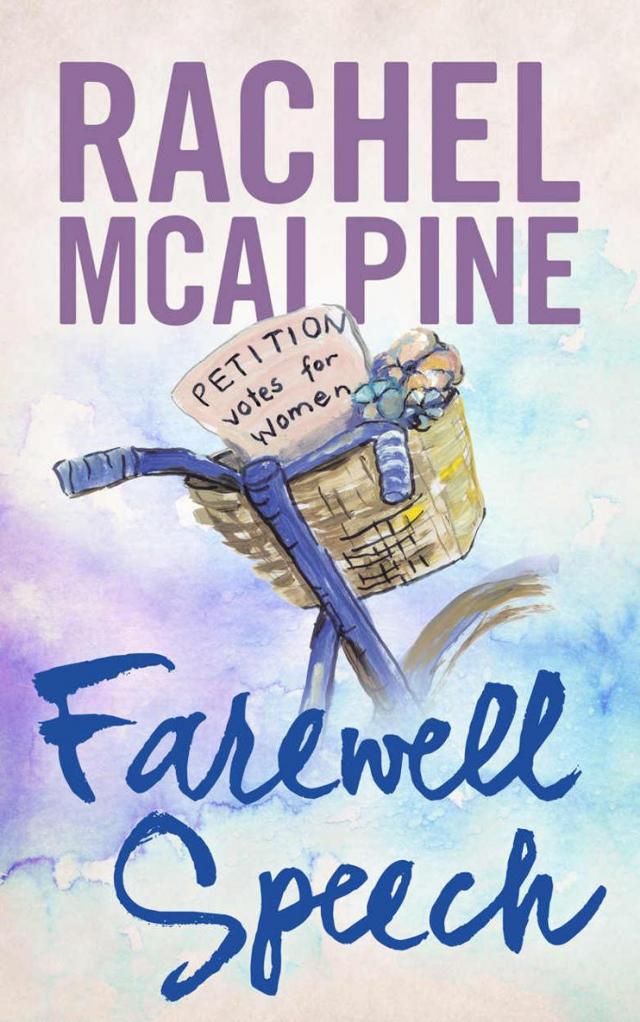


Farewell Speech
Rachel McAlpine
What the reviewers said
Rachel McAlpine is one of New Zealand’s liveliest and most purposeful writers. Farewell Speech is an important novel, focusing as it does on a nation’s history and achievement.
— Fay Weldon
Private hurts. McAlpine has brought alive two of the major protaganists in the great feminist fight of the 1890s, and a third who can be seen almost as a casualty of the cause. What a story! McAlpine has created a compelling piece of drama out of personal as well as public history.
— Liz Grant
The voice of Victorian New Zealand. This book is obviously destined to be a bestseller, and deservedly so, for its writing, it history and its humanity.
— Brian Prendergast
An exciting book. This is a novel about the suffrage movement. But, more importantly, McAlpine brings to life the women whose lives became that movement and, as in her previous fiction, she creates the most marvellous people. McAlpine’s use of language is one of her hallmarks: colloquial, seemingly easy, always appropriate to the character, yet full of surprises.
— Heather Roberts
Beyond ripped bodices. The historical novel, once the realm of Barbara Cartland, ripped bodices and men in high boots, has undergone a metamorphosis and lift in status these days. Farewell Spech takes as its historical base the fight of New Zealand women for the franchise, and in particular the careers of two major figures, Kate Sheppard and Ada Wells. […]Despite the sophistication, Farewell Speech is affiliated to the older, more traditional forms of the historical novel and its association with romantic fiction.
— Jane Stafford
Copyright
Copyright © Rachel McAlpine 1990.
Rachel McAlpine asserts her right to be identified as the author of this work.
All rights reserved. Apart from short excerpts for private study, research, commentary or review, no part of this book may be reproduced in any form by any means without the express permission of the author.
Cover image by Lesley Evans
Cover design by Richard Parkin
ISBN 978-0-9922549-1-9
Kindle edition published 2014
First published by Penguin Books (NZ) Ltd in 1990
ISBN for Penguin print edition 978-0-9922549-0-2
Dedication
This novel is dedicated to a modest person with an awe-inspiring capacity to forgive
Contents
Title page
Copyright
Dedication
What reviewers said
Preface
PART ONE: WHITE HANDKERCHIEFS
1. Bim meets a pig of a woman
2. Ada is lovingly chastised
3. Ada visits the cathedral
4. Kate gets ideas about justice
5. Kate meets a city councillor
6. Kate wakes from a sleep
7. Kate interrogates a preacher
8. Kate’s modest plans explode
9. Ada describes Kate Sheppard
10. Ada grits her teeth
11. Ada rides the iron horse
12. Kate needs a holiday
13. Kate floats on handkerchiefs
14. Kate condones revolution
15. Kate ponders marital relationships
16. Kate fails at arbitration
17. Ada stamps out grief
18. Ada practises hydrotherapy
19. Ada calls for Dr Simpson
20. Kate lists 14 reasons
21. Kate imagines Heaven
PART TWO: MY FAMOUS MOTHER
22. Bim gets a tape recorder
23. An awful kid
24. Noises in the night
25. Enough sad things
26. Ready for rub-a-dub-dub
27. Poor little mite
28. Bim has a growth
29. New names
30. A suitable job
31. Throw off the useless
32. Having a rest
About the author
Books by Rachel McAlpine
Preface
Farewell Speech grew out of a long obsession with my great-grandmother, Ada Wells, and the those who worked for women’s suffrage in New Zealand. It was only in the family that their names were mentioned. At school we were taught about the First Four Ships and the high country farmers, a history of Canterbury’s élite. Yet in world terms their colonial activities were hardly unique, whereas when New Zealand women won the vote the news was an international sensation.
This modern silence about the suffrage workers is reinforced by the people who knew these extraordinary women. Their public lives can be traced easily enough, since all their triumphs and wrangles were fully reported at the time, but not so their private lives. In our family the name of Ada Wells always touched a nerve; all reminiscences were coloured by intense dislike, admiration, embarrassment, resentment and pride. Violent, contradictory feelings are equally common among those who knew Kate Sheppard. As for my Great-Aunt Bim, I didn’t even know she existed until my teens. There is still pressure to censor their behaviour and their views, to polish them into something orthodox.
The more I learned about Ada, Kate and Bim, the more I wanted to understand them. My mystification increased as I gathered more and more information about their lives. Only by abandoning research and writing fiction could I see them clearly. To write Farewell Speech has been to become all three.
I needed to hear them speak and so I gave them each a voice. They speak truths and half-truths and they deceive themselves, sharing the same old human urge to tidy up the facts. They do not tell a sweet, sensible womanly tale but it is their story and ours, and it feels true to me.
PART ONE: WHITE HANDKERCHIEFS
1. Bim meets a pig of a woman
Yesterday morning someone came to see me. A twit of a woman! She made me really mad. I’ve been brooding about that stupid woman ever since.
I don’t know who she was and I don’t care. She’ll never come back here again, I made jolly sure of that.
‘I’m interested in the women’s suffrage movement,’ she said to me. A fat sloppy sort of woman, skin like a pig. ‘I’m doing some research on it.’
‘Oh, are you now?’ I said. ‘Well, I’m interested in stopping this bank falling down.’ I’ve had trouble with that bank for years and years. Planted it with ice plant but it still keeps falling down. All over my drive!
‘I wondered if you might be willing to talk about your own experiences,’ she said.
‘How about doing something useful?’ I said. ‘Grab the other end of this bit of corrugated iron and help me jam it into the sand.’
She made a feeble attempt but she was useless, the iron fell down flat on the drive again.
‘I believe your mother made quite a contribution,’ she said, dusting down her piggy hands.
‘If I bung a couple of stakes in front, that might work,’ I thought. She followed me into the toolshed.
‘I’m going to write a book about it,’ she said.
‘Go on then, go right ahead!’ I told her. I found a couple of sticks and a mallet and she trailed after me back to the driveway. She started giving me a lecture.
‘New Zealand women were the first in the world to win the vote.’
‘Who do you think you’re telling? I had Votes for Women on my porridge from the year dot.’
‘Exactly. That’s why I want to interview you, if that’s not an imposition.’
‘Get to the point, I’m a busy woman. Hold that straight, will you?’
I gave the first stake a good whang and it went in just fine. Pigskin jumped backwards. Never mind, I did the rest of the job without her. It looked all right. I felt a bit wobbly and went into the house to sit down. It wasn’t a turn, I just felt a bit wobbly with the heat. When I came to my senses there she was, sitting in my chair at my table and plugging in a tape recorder thing.
‘Would you like a drink of water?’ she asked. In my own house!
‘You want to hear about my mother?’ I asked.
‘That’s right,’ she said. ‘You’re almost the only one who can do it now.’
I hooted. ‘They’re all dead! Dead! Mother’s dead and Chris is dead and Cos is dead — I’ve outlived them all. Nobody left to boss me around.’ I’ve got the last word now, there’s only me, me and my pumpkins and chooks and my old cats. Oh, I laughed and laughed!
She turned on the tape recorder. ‘When did your mother first meet Kate Sheppard?’
That stopped me in my tracks. ‘What’s it got to do with her?’
Pigface popped her eyes. ‘Why, everything, Miss Wells. Mrs Sheppard was by far the most prominent figure in the suffrage movement. In New Zealand, that is.’
‘Do you want to know about my mother or don’t you?’ I asked her point-blank.
She looked a bit scared. ‘Of course I do. That’s why I’m here.’
‘Then stick to the point,’ I said. ‘What are you calling this book of yours?’
Got her! ‘The Sweet Suffragette.’
I exploded. ‘There was nothing sweet about Ada Wells!’ She went on about Kate Sheppard and I told her straight. ‘My mother did as much as her!’
She didn’t want to know about Ada Wells! Not on your life she didn’t. I sent her away with a flea in the ear.
I sat in the kitchen fuming. I could see what she was up to. She wanted to start it up all over again, that hero worship of Kate Sheppard, just because she was the obvious one, the leader and s o forth. That woman won’t be happy till we’re all on our knees kissing Kate Sheppard’s foot, just like they did in the old days.
Kate Sheppard Kate Sheppard Kate Sheppard! That’s all I heard for years and years from my mother and the newspapers and all the lot of them. On and on! How she was famous all over the world and what a good writer and a marvellous speaker and how the women loved her and the men loved her, and how she made the politicians give us the vote. I got heartily sick of the perfect Mrs Sheppard.
That was a long time ago, mind you. Must be fifty years ago she died. That was in 1934, the year after Mother. Nobody talks about her now, nobody even knows her name except for that bookshop.
It was all in the air, her fame, it just blew away. It’s queer the way they’ve rubbed her name out.
Every time the newspapers do a jubilee or a royal trip they sing the glories of the so-called history of Christchurch.
They’re all very proud of themselves around here, even though nowadays the South Island is right out of fashion. Those people in the North Island seem to think they run the country, they’re the be-all and end-all of New Zealand, they think we’re just a bunch of country bumpkins down here in the South Island. It makes me so mad! It wasn’t always like that, my word no, not in the heyday of Mother and her cronies. Mind you, there was always a difference between the city and the province. Christchurch and Canterbury were two different places altogether. One was full of wild women, the other was full of snooty farmers, beg your pardon, run-holders.
Oh, I could tell a thing or two about Christchurch. They wanted to build a Brighter Britain, ha ha, they gave every place an English name and they put up a heck of a lot of blocks of grey stone. People think Christchurch looks quaint with its English cathedral and English courthouse and schools and university and even a loony bin built like a castle. Gothic! Gothic! Trying to bring the Middle Ages back, they were. That’s not what Mother wanted.
And we’ve got our sleepy little Avon River just like the English one, looping around all those show places and the daffodils and the blossom trees. And the nice view of the Southern Alps in the distance.
Very pretty on the outside, Christchurch. But I know what went on behind those big pointy wooden doors, and behind those front doors in the upper-class suburb of Riccarton and the plain doors of St Albans, that’s where we lived, that wasn’t half as grand, oh yes I do, I know. I’m glad to be out of it.
I like it here in New Brighton. It’s all new here. I’m still living in Christchurch but it doesn’t feel like Christchurch because I’m by the sea. Blow me down, why didn’t they push the city out to the seaside years ago? Why did they keep pushing us further and further into the swamp?
But look here, this is the point, when the papers do their special issues about how wonderful Christchurch is, there’s never a mention of the amazing Kate Sheppard, let alone my mother! It’s always about the wool barons or some big brewery. I’ve never touched a drop of drink in all my life.
It makes you think. All that fuss, those years and years of work and all those things they did. All blanked out.
I had a bit of a lie-down but I couldn’t sleep. When the heat of the day went off, I went out to have a look at my driveway. That blankety-blank bit of iron had fallen down, and more clay and sand all over the drive. Darn thing. And to make it worse, Stan turned up. I could do without him after a day like that.
‘You again,’ I said. ‘What do you want this time?’
‘Having trouble with your bank?’
‘That’s right, state the obvious.’ He’s so wishy-washy.
He prowled up and down and took some measurements and said, ‘If you’ll order the concrete blocks I’ll make you a retaining wall. I could do it in a couple of weeks.’ And he wrote down the number of blocks and so forth. I didn’t take any notice. He was dreaming, he couldn’t pour concrete, he’s a boob and a weakling. ‘I’ll do it in a nice curve, and you can get the ice plants to trail down over the front.’ Always worrying about what things look like.
‘Stop fussing,’ I said. ‘I’ll sort it out for myself.’
He took a box of fruit and veges into the kitchen and put it on the table. ‘It’s a good crop this year,’ he said. So proud of his cherries! Anyone can grow a garden. He saw the business card that woman left. ‘What’s this?’
‘A twit of a woman came round,’ I told him. ‘She says she’s writing a book about Kate Sheppard.’
‘There should be one about your mother,’ said Stan.
‘Don’t be stupid. Nobody’s interested in her,’ I snorted.
‘People don’t give her credit. She did the best she could. She just didn’t always follow through.’
I bristled. How dare he criticise her? ‘Out you go! Out!’
He’s used to my ways, I’ll say that for him. I started to push him out the door but he was one jump ahead of me.
‘You could always do it yourself,’ he called over his shoulder. My word he can be vicious.
All night I thought about it and I got madder and madder. It’s awful! To think there’s no one left to remind the world of all she did! And in the end I got just about mad enough to do the bally thing myself.
Chris and Cos would die of shame if they knew what I was up to now. Because I’ve decided. I’m going to give it a go. I’ll tell everything I know about my mother, the whole bang lot.
I can write, I’m no fool, whatever they say. Look what I’ve written already! Pages of it! It’s just that my arm gets a bit sore. I’ve got a lot of Mother’s stuff in the dresser, newspaper cuttings and so forth, that’ll make it easier.
I’m glad they’re dead. I can give my version. Chris and Cos wrote her obituary for the Press and they made it all flowery. Here’s a flowery bit:
‘A cause might be despised, obscure, rejected, she not only helped it all the same, she helped it all the more, and in the dark and stormy days of unfounded truth, she was always to the front.’ That sounds nearly like a poem, she’d like that.
Other people got even more carried away. Who on earth wrote this one? ‘Her work was never merely on the physical plane: the whole experience of a full life shone with infinite gentleness in her face and flowed through her hands.’ Here’s a good bit: ‘Standing alone in a cause was to her the natural outcome of advanced thinking. From the path of duty she never flinched, believing that spiritual forces in which she trusted implicitly were infinitely greater.’
I can’t write like that. I’ll say what she did and people can take it or leave it. Mother used that la-di-da language. That’s where Chris and Cos got the habit. Always quoting poetry. Her mind was on higher things but she was as tough as old boots.
I might not call her Mother in this story, I might call her Ada. No, I couldn’t do that. She might be angry if I called her Ada. But she’s not here, she’s dead! She wasn’t a member of the Worldwide Church of God so she won’t be there among the elect. Some people thought she was a bit of a saint, but there was no Worldwide Church of God in those days so she couldn’t join. It’s very strange that I am one of the elect and she’s not.
I hate old age. I stopped going out to patients when I was eighty, I couldn’t ride the bike any more after that.
I get so mad when I can’t do things.
When I had the lumbago, that upset my legs, that crippled me. I think it’s due to the back and I’d have given anything for some rubs. My own rubbing, I mean. I do what I can but I can’t get round to the back. When I went out to the garden to do a little bit extra, it would ache all the way down and I simply shook with it, a horrible feeling.
But the doctor came and saw me bending over the paths, and he said, ‘Are you taking your heart pills?’ So I went back to them and it’s made such a difference.
I don’t go into town much now. But I go for a swim every day, put my coat over my bathing costume and walk over the sandhills to the beach. There’s nothing like salt water, it’s good for the whole system. I do love my swim. And it saves the hot water.
I mustn’t wander off the point. Nobody’s interested in my lumbago.
Anyway here I am, I’ve started: I’m strong enough to do it. But now I’m going to stop. It’s taken me two days to write this much. She was writing a book herself when she was ill, I saw it. I wonder what happened to that stuff she was writing? I don’t think Chris got it.






