Lady of the bees v1 0, p.1
Lady of The Bees (v1.0), page 1


The soldier made me think of a donkey with a pannier; his back supported a bar, the bar a basket on either end, and in each basket, an infant boy, one fair, one dark.
He stopped when he reached the hut of Faustulus, the King’s shepherd. “These are the grandsons of Numi-tor,” he said, handing the bar to the grizzled old man. “Babies grow up to become princes. Princes lead rebellions and fulfill prophecies. The King wants you to drown them.”
The shepherd nodded. “Yes. The King is wise. I tend sheep, but I am also a priest of the goddess Rumina. To kill princes, Amulius would choose a priest—and one in the country, so the deed will not be known in town. Yes, I will give them to the Tiber.”
Luperca and I exchanged glances. We knew what must be done. Still…a Dryad and a she-wolf—we were hardly a promising team for the rescue of the twins.
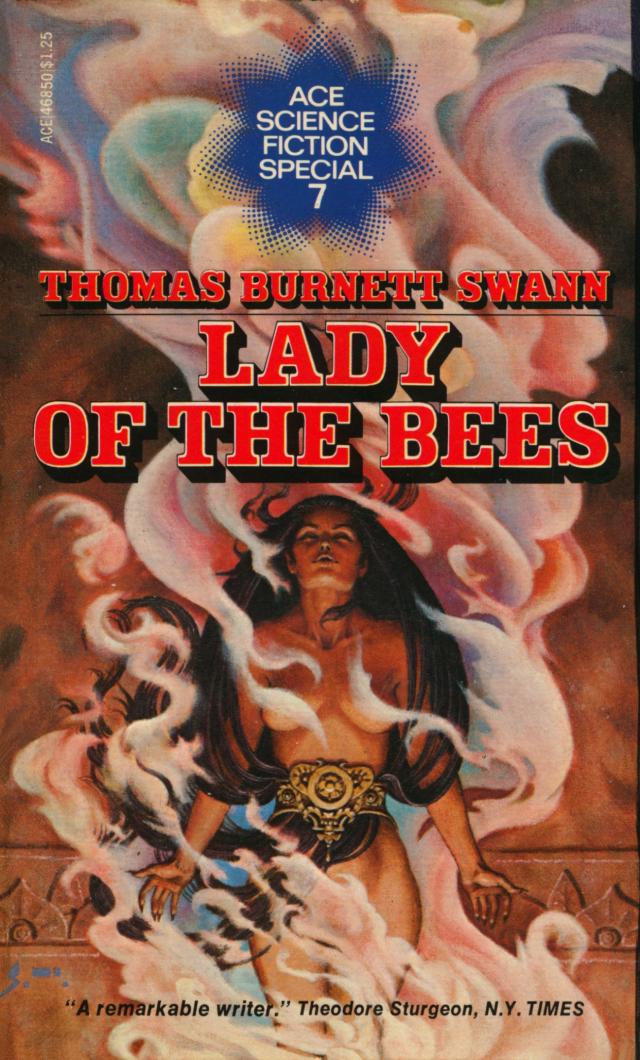
THOMAS BURNETT SWANN
LADY
OF THE BEES
ace books
A Division of Charter Communications Inc.
1120 Avenue of the Americas
New York, N.Y. 10036
LADY OF THE BEES
Copyright ©, 1976 by Thomas Burnett Swann
Portions of this novel appeared under the title of “Where Is the
Bird of Fire?” in a collection of novelettes published by Ace
Books in 1970, WHERE IS THE BIRD OF FIRE?
All rights reserved. No part of this book may be reproduced in any form or by any means, except for the inclusion of brief quotations in a review, without permission in writing from the publisher.
All characters in this book are fictitious. Any resemblance to actual persons, living or dead, is purely coincidental.
An ACE Book
First ACE printing: May, 1976
Printed in U.S.A.
TO STELLA STEVENS, STAR
Inimitable in beauty, incomparable in genius, love goddess to a godless age
HISTORICAL NOTE
The degree of civilization reflected in this novel, the architecture of temples and palaces, the sculpture of images exquisite in gold or malachite, the religion of humanized deities with great personal beauty and a very personal interest in nubile princesses, even the calendar divided into twelve months, did not belong to the relatively primitive peoples who created Rome. Rather, I have followed the Roman poets in idealizing their past. Most modem historians contend that Romulus and Remus were merely myths; that the first settlers on the Palatine were illiterate shepherds and thieves; that Rome, far from being founded, grew haphazardly from a village of wattle huts into a city of concrete, bricks, and marble. They are doubtless right.
Still, poetry and fiction possess a truth which eludes history: to interpret rather than record. My novel is an interpretation.
MELLONIA
I
My name is Mellonia, the Dryad, though the Fauns have, named me the “Perpetual Virgin” in a forest where virginity is as rare and reprehensible as promiscuity among’ the humans of Alba Longa. The Lemur or ghost of my Aunt Segeta adds the damning words, “By choice.”
True, I have had two lovers.
“But that was in the time of Saturn, wasn’t it?” Segeta insists.
“No,” I protest. “It was much, much later. It was four hundred and fifty-three years ago—you should remember—when I lost my maidenhead to Aeneas in a hollow tree.”
“All the same, Niece,” she shrugs, “you’ve had sufficient time to grow a new one. And what, by Sylvanus’ holy rod, are you saving it for? Don’t make my mistake. I was a mere fifteen males short of being a virgin when I died. You may recall that I started rather late.”
“I’m saving it for Mercury when he comes to guide me to the Underworld. Or Charon. After all, I have to buy my passage across the Styx.”
“It won’t buy you a ride with the Gray Ferryman. He’s older, they say, than Saturn. You’ll wander the Nether Lands like me. Besides, nobody knows for sure that there is another side to the Styx.”
“The Elysian Fields—”
“An invention of poets. Much too pretty to be believed. To me, the-Styx resembles an ocean with only one shore. Ask any Lemur. He will tell you the same.”
“Very well then, I’m saving it for another Aeneas, another Ascanius.”
“The waste, the wicked waste,” she mutters, gazing upon me with horror and fascination. “Four hundred and seventy^years of Dryad in the body of a young woman. Streaks of age in your hair, but gold, by Aphrodite’s girdle, instead of a mossy silver! You may not be the slip of a girl Aeneas loved, and after him that splendid young warrior, his son Ascanius, but you’re a woman all right—four feet of walking temptation, full breasts, curving hips, and you still look young, though your tree must have sheltered Saturn. You might at least get fat or gather a few wrinkles or grow knock-kneed. As it is, you walk about like a fig tree ripe for plucking, but no, your fruits are not for the likes of a Faun—scroungy, you call him—or a human, unless he happens to be a great hero, and great heroes, my dear, do not belong to the present age. I don’t even meet them in the Nether Lands.”
“Perhaps they have found a way to cross the Styx,” I say, adding, “I will cook you a meal.” I feel by now as if I ought to wear sackcloth or crop my hair to atone for my chastity .“Lentils and beans?”
She looks prepared to disdain such plebeian fare; she deigns. “Oh, very well. I do feel a trifle immaterial.” She can neither chew nor digest, but she encompasses and absorbs the food with the amethyst mist, translucent and billowing, which has replaced her body, and she gains sufficient sustenance to resume her admonishment. A single bean lingers and revolves in what should have been her stomach.
“If you don’t choose a lover, and soon, Venus will nip you in the bud. Listen to old Segeta. You’ll see!”
“Ah,” I mutter, “if only she would,” but amethyst mist, it seems, is hard of hearing (like certain goddesses).
With Fauns in the woods and men in the nearest town, Alba Longa, I usually keep to my tree, notwithstanding admonitions from a ghost. I do have my visitors. The Telesphori come to ask me the herbs and simples I use to keep what they call, in their formal and stately diction, my pulchritude. Shy little healers in muffling green hoods, they show their faces and feet, pink as the throat of a conch shell, but you have to guess their tails. A bear escaping from hunters may find a refuge at my table, in spite of his uncouth manners. Bees spin circles around my windows to tell me of honeycombs in hollow logs. Even woodpeckers, usually the scourge of oaks, rest on my limbs without hammering a nest. But Fauns are as disagreeable as a thunderstorm. And men—well, men have diminished since Ascanius’ day. Not in number; not, alas, in size. Indeed, they have multiplied and, wearing hel- mets, they look like Achilles and Ajax and other giants from that giant and tragic war, the siege of Troy. What they have lost is the valor, what they have lost is the vision, which they brought with their household gods from their falien city. Belated Trojans, they have forgotten Troy. I am not afraid of them. I am not concerned with them.
In a moment of rare self-pity—increasingly frequent, I fear—I confide in the young she-wolf, lately a cub, whom I saved from a table set by hungry Fauns.
“Luperca, Venus has surely cursed me, just as Se-geta threatened, though in quite the opposite way. Instead of nipping my bud, she has afflicted me with eternal bloom. I found you only a cub; now you are a yearling; fifteen years from now you will be a grizzled old wolf, and then you will go to your rest. I alone have broken the ancient cycle of winter burgeoning into spring and summer subsiding into the sweet oblivion of autumn. Who is so much enamored with morning that she can endure the glare of the sun while civilizations reach their titan hands to grasp the sky and falter empty-handed into the dust?”
Luperca sniffs impatiently for her dinner. She does not approve of my high-flown lamentations.
“Oh, very well,” I say, petulant at the loss of my audience. “I shall fix you a stew of squirrels and sparrowgrass. I know you dislike the second, but the first will make you fat, and mates are scarce these days— at least for wolves.” Luperca opens her mouth and lolls her tongue.
“Patience, good daughter. Yes, you prefer your squirrels uncooked, but you are my guest. You must eat what I choose to prepare.”
I hear a persistent knocking on my tree.
Pestiferous woodpeckers, how many times have I told them to light but not to knock-
It is not a woodpecker, it is a Faun. I can tell as he kicks my trunk with his cloven hoof.
Angrily I open a circular window block, confront a stranger, and laugh in his face…
II
Like all of his race, whatever their age, he resembles a comical child. He gapes at me as if I were about to switch him with a hazel rod; at the same time, I read the eternal mischief of the Faun: a child’s mind, a boy’s cunning, an old man’s lust.
“I don’t know your name,” I say. “I know what you want.”
“May I have it? My name is Nemustrinus. Come down from your trees.” My window is high above his head.
“What will you give me?”
“Pleasure, what else?” He seems to forget that his odor of stale fish, and his coarse hair, matted with dirt and brambles, are not enticing to every woman.
I have learned to make a weapon of banter. “I must be bought.”
“You sound like a human girl,” he complains. “The Lemur of my great-great-great-uncle—I forget the number of greats”—Fauns can never add—“tells me that in the reign of Saturn, every Dryad thought it
“I did not live in the time of Saturn. In my own time, however, I was a queen and my subjects numbered a hundred or more, and our circle of oaks, the Wanderwood, was stronger than any fort We never coupled with Fauns. True, the days of my reign are gone, and so are my subjects, victims of plague and blight and the axes of heartless men. I am quite alone among the tenantless trees. Still, I refuse tq couple with a Faun.”
“Oh,” he said. “You must be Mellonia. I know about you.”
“What do you know?”
’The virgin.” He might have said whore.
“I have had two lovers. I hardly qualify.”
’That was an eternity ago.” Farms age more quickly than humans, much more quickly than Dryads, and count themselves blessed to achieve their twentieth year.
“I have a long memory.”
“I could do you a favor. I could take you to the burying.”
“What sort of burying?”
“That’s my secret. It’s among the humans of Alba Longa, though.” He is young for a Faun, eighteen months old at the most; his face, if you ignore the horns, is not uncomely, though the lips are thick, the nostrils flat and flaring; his chest is a copse instead of a forest, but the flanks, those hirsute horrors which all of his race inherit from their patron deity, Faunus —well, I could never endure them. Does it come from their diet of refuse and sour milk?
“Such a long walk,” I temporized.
“Why, you can outrun a deer. Thafs how you’ve kept your maidenhead. The one that grew back.”
“I won’t promise,” I said, curious in spite of myself. I envisioned a princely treasure about to be buried by thieves, a sunburst of gold and electrum, a tiara of malachite. I envisioned the burial of a great personage among the humans, a king or a queen, and hornets of envy assaulted me, a longing to watch (or even replace?).
Perhaps I would stroke his ears in return for his gift. Perhaps I would ask him to a supper of sorel and fennel stalks, though not in my tree. I could almost forget that n Faun had killed Aeneas.
“I won’t promise, but come, show me your burying.”
“Quiet now,” he said. “No one must see us. Fauns are no more welcome than goats in Alba Longa; they mistake us for thieves.”
“And rightly so.”
He looked at me with his slanted goat eyes. “You know what they do to Dryads.”
“Put them into a circus.” The Alba Longans had copied their circuses from the Etruscans. There were conjurings of the dead, divinations from the entrails of a sheep, duels between men and animals, wrestling matches. There were shows in which sea-born Tritons were floated in tanks of river water (until they died) and Centaurs were chained to chariots and forced to race (they generally broke their necks) ^ They had captured my Aunt Segeta for just such a wanton display. Away from her tree, she had died within a week, as brittle and brown as an autumn-crisped leaf.
Alba Longa was not a second Troy, if I could judge from Aeneas’ description. Still, it was great and terrifying to me—a fortified mound with crenellated, turreted walls of cyclopean rocks, and massive bronze gates which resembled a Cyclops’ jaws. The roofs of platformed temples, Etruscan style, peaked sharply above the walls. A road of basalt blocks, the Sacred Way, serpentined from the gates between rows of cypresses, skirted the woods and led through open fields and herds and grassy hills to Veii, the City of a Thousand Images. Warriors afoot or in chariots constantly patrolled the roads and the forest did not encroach, it shrank like a wounded squid and gathered concealing thicknesses to hide its folk. I found the thicket closest to the road and trusted the green of my hair to pass for leaves, the gold for asters or daffodils. Nemustrinus, crouched and hairy, resembled a strayed goat.
A long procession descended the avenue, proceeded and flanked by guards, those men with bronze greaves and tall, iron-tipped spears, and eyes as cold as the metals in their armor. Where was the casket or catafalque? No, I recalled, the men of Alba Longa cremated their dead. Where was the funerary urn? I could only see the Vestal Virgins, those white immaculate flames, and a man enrobed in purple—the king’s color—with a sharp black beard like a wedge and slanted Etruscan eyes. I recognized Amulius. He had stolen the throne from his brother, Numitor, the benign if absentminded astrologer who had studied the stars before every decision of state and, indeed, was studying Gemini when Amulius’ soldiers seized the throne. Amulius kept him a prisoner in the palace except, as now, when he wished to parade him before the people who, having prospered under his docile rule, would have resented his death. His neatly trimmed beard—trimmed, no doubt, by the King’s barber —and ruddy countenance—ruddied no doubt with carmine by the King’s eunuch—gave him the look of a guest instead of a prisoner.
And the girl…
Ah, she might have been me when I lost Aeneas—young beyond belief, stricken, but proud in her innocence (I knew her innocent). They had shackled her wrists; they could not shackle her pride. I always judge a person by his eyes. Bad men veil their thoughts, and yet I can stare out malice, theft, rape. I look behind the eyes. Aeneas’ eyes were azure bits of sky; they seemed to yearn for their celestial home. Some dismissed him as an ineffectual dreamer; I saw the bronze behind the dreams. Ascanius’ eyes were gray. Hard, said his enemies. “A rough piratical fellow,” he liked to laugh. I saw the loving son, the devoted brother, the faithful lover. This girl’s eyes, black in the noonday sun, revealed her as inexperienced in the ways of men, but one who would never willingly have renounced the world and become a cloistered Vestal. Amulius had given her to the Goddess when he dethroned her father. Now, it seemed, he thought her a threat.
“Nemustrinus,” I whispered. “She is Numitor’s daughter, Rhea Silva, descended from my own Ascanius!” In spite of his love for me, Aeneas’ son had taken a mortal wife to give him a human heir. The son I had borne Aeneas had died of a chill because of his Dryad blood. Ascanius would not let me bear him a child who was “half of the forest, half of the town, belonging wholly to neither.”
“Yes,” said Nemustrinus, expectant of his reward.
“But what has she done?”
“Watch!”
I saw a soldier who made me think of a donkey with a pannier; his back supporter a bar, the bar a basket on either end, and in each basket, an infant boy, one fair, one dark.
“But Rhea was a Novice, a holy girl.” Even in my tree, a half day’s walk from the town, I learned such things from the Forest Folk. “She would have become a Vestal.”
“Yes,” he grinned. “To honor Vesta, the Hearthfire. Vesta, the Virgin.”
“And yet this Novice, this would-be Vestal—”
“Bore twins a month ago.”
“Who is the father?”
“Mars, the girl insists. He came to her in a dream. A young artisan, says Amulius. There was a trial. There was a witness. The boy was beheaded. See? On the stake before the gate.”
The head was unrecognizable. The vultures, birds of good omen among the Alba Longans, had been encouraged to feast.
“I believe her,” I said. “Gods do descend…” I thought of Aeneas, the son of Venus.
“And men climb in windows,” he laughed. At first I had tolerated him; now I despised him. My fingers tightened around the onyx dagger I wore in my sash.
“And they are going to—”
“Bury her.”
Stupid, stupid! Where was my vaunted intuition? I had willingly followed him to a burial, not of a treasure, not of a dead queen, but of a living girl.
“See!” he exulted, his pointed ears aquiver like those of a goat with flies. “That mound of earth—”
“Hush. Do you think I’m blind?”