Hoops, p.1
Hoops, page 1


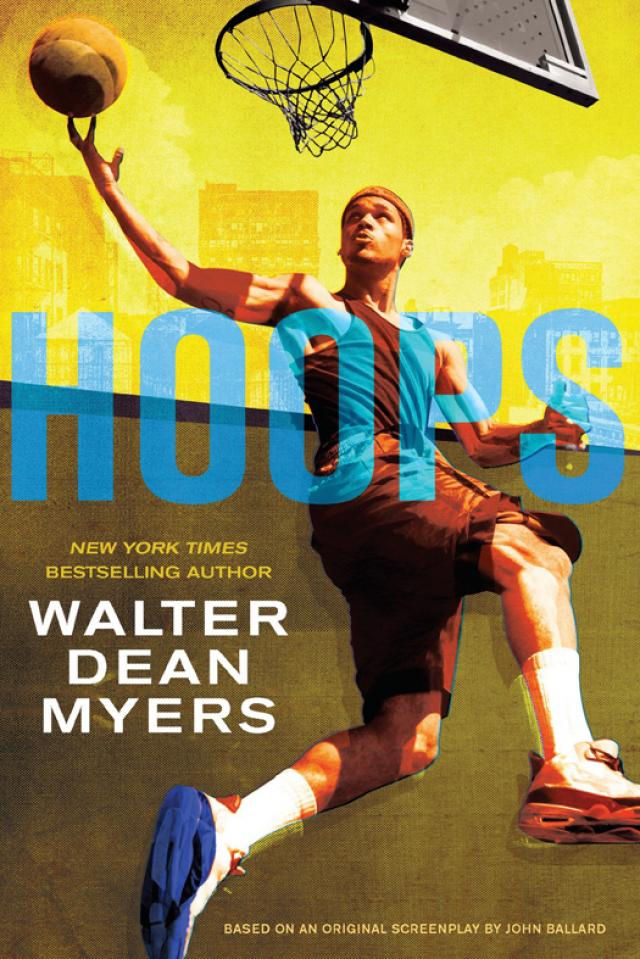
ALSO BY WALTER DEAN MYERS
On a Clear Day
145th Street
Darnell Rock Reporting
Me, Mop, and the Moondance Kid
The Outside Shot
What They Found
This is a work of fiction. Names, characters, places, and incidents either are the product of the author’s imagination or are used fictitiously. Any resemblance to actual persons, living or dead, events, or locales is entirely coincidental.
Text copyright © 1981 by John Ballard
Cover art by Ian Keltie
All rights reserved. Published in the United States by Ember, an imprint of Random House Children’s Books, a division of Random House LLC, a Penguin Random House Company, New York. Originally published in hardcover in the United States by Delacorte Press, an imprint of Random House Children’s Books, New York, in 1981. Based on an original screenplay by John Ballard with additional material by Dennis Watlington.
Ember and the E colophon are registered trademarks of Random House LLC.
Visit us on the Web! randomhouse.com/teens
Educators and librarians, for a variety of teaching tools, visit us at RHTeachersLibrarians.com
Library of Congress Cataloging-in-Publication Data is available upon request.
ISBN 978-0-307-97611-6 (tr. pbk.)
eBook ISBN: 978-0-553-51212-0
Random House Children’s Books supports the First Amendment and celebrates the right to read.
v3.1
To my father,
Herbert Dean,
who bought my first
typewriter for me
Contents
Cover
Other Books by This Author
Title Page
Copyright
Dedication
Chapter 1
Chapter 2
Chapter 3
Chapter 4
Chapter 5
Chapter 6
Chapter 7
Chapter 8
Chapter 9
We Asked Walter Dean Myers …
A Conversation with Film Producer John Ballard, About Hoops, Based on His Original Movie Screenplay
Excerpt from On a Clear Day
Excerpt from 145th Street
On a Clear Day
About the Author
One of the things my father used to say was how his days were piling up on him. When I told him I didn’t know what that meant, he said one day I would.
“Right now,” he said, “you got your days filled up with playing and going to school. Then after a while you gonna start dreaming about this and that, and you gonna lay your days out in front of yourself like an imaginary road. That’s what I did.”
“Then what happened?” I asked.
“Then they started piling up on me,” he said. He looked away and didn’t say anything else, and I knew the conversation was over. When he looked away like that, there wasn’t any use to keep on talking.
After he split, I stayed around the house a lot. I did most of the things I was supposed to do, like making the school scene and helping out around the house. I got a little job at the Grant, a little run-down hotel, when I got to be sixteen. That was really okay. I could earn a few bucks, and I could crash there when my moms got on my back too much. By my senior year she was on my back just about all the time, too. Something had come up between us that put an edge on everything we did. It wasn’t anything I could really lay out and say, “Hey, there it is,” as much as it was a feeling. I’d be sitting in the kitchen eating and she’d come in and make some remark about how late I was staying out or something, and I just wouldn’t want to hear it. So I’d finish eating as soon as I could and then bust over to the Grant to spend the night there and cool out.
When I thought about it, I knew it wasn’t so much that I had changed, or even that she had changed, but the situation was different than it had been, and we couldn’t talk about it. When I was younger, I used to tell myself I was going to do this or do that and I believed it. Now I didn’t know. For a long time Moms hung on to that old stuff, about me going to college and making something of myself. When I would lay in bed at the Grant, waiting for the next day to roll around, I was also waiting for something to happen, something to change my life. It was like I was running in a marathon and suddenly forgot where the finish line was. But I knew I still had a place to get to, even if I couldn’t see it, and I knew I was scared to stop running.
* * *
All along, though, I had my game. My game was my fame, and I knew it was together. From the first time I played basketball in grade school I was good. I was good, but I was short then. Some of the older guys used to call me runt. “You got a sweet game for a kid, runt,” they’d say.
I was always on the court practicing, trying to get my game more together. I used to imagine being the shortest guy in the NBA and scoring the winning basket in the championship.
Then, when I got to be fifteen, I started to grow. When my seventeenth birthday came around, I was six three. Now, my game was sweet when I was short, but when I got taller, it was really nice. I played ball just about every day for about three years straight until near the end of my senior year. Then, all of a sudden, I began to go through a whole lot of changes. I was feeling okay, but I just didn’t want to do anything. I’d sit around and try to decide what I wanted to do, and that would take an hour or so, and then, when I decided what I wanted to do, I still might not do it because I just didn’t seem to have the energy. Then, to top things off, sometimes if I did really break out into a hustle and do something, it would get messed up. I wasn’t sure it was me or if things just weren’t going my way. The Scotch is a good example of what I mean.
I had had some words with my moms after I had left a tea bag in the sink.
“What’s the matter?” she said with her hands on her hips. “Your arm so bad off you can’t reach over there and put the tea bag in the garbage?”
I didn’t say nothing.
“You know that tea bag is going to leave a stain and you’re not going to clean it.”
“I’ll put it in the garbage,” I said.
“Oh, no, Mr. Jackson,” she said in this high voice. “Please let your servant do it.”
Then she snatched up the tea bag and put it in the garbage.
“So why didn’t you just do that in the first place?” I asked.
“Why didn’t I do that in the first place?” She bent over from the waist and looked up at me. “Who do you think I am, boy? I’m your mother, not your servant!”
I listened to that until she got tired of running it; then I split on over to the Grant. I couldn’t believe all that flap over a tea bag. I was pretty mad by the time I got to the hotel. I got the keys and went up into one of the empty rooms on the third floor and just sat in the window. I looked over towards the liquor store to see if I could see the clock. I couldn’t, and I started to turn away. But something wasn’t right. When I looked again, I could see the guy that ran the store standing close up against the shelves, and the clerk was standing right next to him. It looked like there were two other guys in there, too. One of them was a guy who delivered liquor to the store, and the other guy I didn’t recognize, but I saw he had his hand in his jacket pocket. That’s when I realized the store was being held up.
Now the truck with the booze to be delivered is outside in the street and the driver is inside being stuck up, which gave me an idea. I busted down the stairs and into the street. I look into the liquor store, and I see that the guy with his hand in his pocket and a third guy I hadn’t seen from the window are making everybody go into the back. I go over to the truck, open the back, and there’s a case of Johnnie Walker close enough to grab. I look around to see if anybody is checking me out, but the only people on the block are some kids. I cop the case of Scotch and hightail it back into the Grant and up to my room.
I figure I can get at least five dollars a bottle for the Scotch, and there are twelve bottles to a case. I’m feeling pretty good about the whole thing by the time I get the case under the bed. I go back to the window. There’s this young brother up on the truck, and I figure he’s going to cop, too. But instead of copping a case of something like I did, he takes a padlock off the truck and throws it to another kid. This kid runs up to the liquor store and puts the padlock on the door.
One of the guys inside the store sees what is going on and runs over to the door, but it’s too late. The kid has locked them all inside. Then about four or five other kids start unloading the truck. Meanwhile, the guys inside the store are banging on the window and hopping up and down and stuff. By this time it seems that half of Harlem is in on the action. One wino opens a bottle and is in the middle of the street, directing traffic. It takes about ten minutes to unload the truck. The whole block turns into a big party. Finally the cats inside the store shoot out the window just as a police car comes around the corner. There are a few shots fired, but nobody gets hurt, and soon everything is back to normal except for the glass on the street.
It was funny to watch, but then I realized that everybody on the block had Scotch and everything else now, and I wouldn’t get nothing for mine. Still, I figured I could lay with it until everybody had drank theirs up. But that was the way my luck was running—even things that looked sweet weren’t working out right for me.
I got depressed about the whole thing. I sat in the window and watched the people down in the street having a good time, and I began to feel worse and worse.
I have a funny way of thinking—at least I think it’s funny because I don’t hear anybody else saying they think the way I do. What I do is to think things part of the way out, and then I put them aside and think them out some more later on. I had begun to think about what my father had said a long time ago about your days piling up on you, and as I sat in the window of the Grant, I began thinking about it again. It was beginning to make more sense to me.
School was going to be out in another five or six weeks, and then I was going to have to figure out something to do with myself. Before, I’d spend the summer playing ball and waiting around until school started again, so that would take care of itself. But now that school was just about over for me, the days seemed different, and I had to figure out what I was going to do with them. I knew I didn’t want to work at the Grant all the time. I hated Jimmy Harrison, the manager, and the job was a chump job anyway—sweeping floors and changing beds and that kind of thing. The only thing that made it not so bad was me telling myself it was just until I finished school. I saw a lot of guys who had either finished school or had dropped out just hanging around the block, and I didn’t want to do that either. I wondered if my days were piling up on me, like my father said they might. They were changing, at least, or maybe I was changing. Or was supposed to be and wasn’t.
I sat in the window for a long time, and then I laid across the bed, just waiting for time to pass. I dozed off for a while, and when I woke, it was just about dark. I thought about going to a movie but decided to save my money so I could go the next day in case it rained. I got a basketball I kept at the Grant and wandered over to the playground. The lights were on, and I figured I’d shoot a few baskets. Playing ball, even shooting baskets by myself, always made me feel better. I figured to shoot until I got tired and then come back and get some sleep.
I had my head so wrapped up in myself I didn’t see this guy laying on the court until I got right up on him.
“Hey, man.” I nudged him with the toe of my sneaker. “Get off the court!”
When he didn’t move, I thought he might be dead. I nudged him again.
“Your feet too big …” That’s what he said, only he kind of sung it instead of talking.
“Hey, man, get up!”
“I really hate you ’cause your feet too big …”
The cat is laying there singing some kind of weird song. I pushed him with my sneaker again, and he didn’t move. So I gave him a kick on the back of his leg and told him to move again. He rolled over and got up on his knees and hands like a boxer trying to beat the count. I thought he was getting right up, but he just stayed like that for a while. I reached down and grabbed him by the collar and started to drag him off the court, and then, all of a sudden, he’s up. Not only is he up, but he’s got this blade in my face!
I dropped the ball and backed off. This guy smells like somebody done peed in bad wine and washed his teeth in it, but he’s got this knife, and he’s bigger than me.
“Hey, why don’t you get off the court, man?” I said.
“I really hates you ’cause your feets too big …” He starts in with this singing again, and I just watched him. I didn’t want to get too close to him ’cause I still didn’t know where he got the knife from and he was quick.
He stops just before he gets off the court and turns back to me and just looks at me, and then he puts his knife away. Right away I feel like busting his jaw. I take a step toward him, and he just grins at me.
“Get off the court, old man, before I hit you!”
“Why don’t you put me off the court, youngblood?” he says, still grinning.
I look at him for a minute, and he don’t look like much. But I’m six three and he’s maybe six four, and he’s heavier. I wasn’t scared of the cat, but I figured it wasn’t worth my while. I could hit him and he’d have a heart attack and die and I’d be up for manslaughter or something.
I picked up the ball and shot it. He turned and walked off, still singing that stupid song about feet. I shot a few times, and then the ball came down on something—a broken bottle of wine. I started to push it off the court with my foot, but then I picked it up and threw it off as far as I could. I got the ball again and shot and shot until I was too tired to shoot anymore. Then I took the ball over to the track and ran laps until I could see the sky start turning gray between the buildings.
The next morning Harrison had me cleaning rooms with him and listening to a lot of guff about how hard he had it when he was my age. He’d heard that I was the first to cop from the truck the day before and asked me where I was keeping my stash.
“Don’t worry about it,” I told him.
He gave me a look hard enough to curdle water and went on sweeping. After we finished cleaning the rooms, I split to Mary-Ann’s house.
Mary-Ann is just about my woman. Just about, because I haven’t really done anything to make it official.
I’ve known Mary-Ann and her brother Paul just about all my life. For a long time I treated her like a younger sister. Paul and I were close, too. If I had to call somebody my main man, he’d be it. We were just about the same age and had been going to school together, eating at each other’s house and stuff like that for as long as I can remember. Lately Paul had been hanging around with some of the cats at school who thought they were better than the rest of us. This was a new thing with him, and I couldn’t figure it, but I gave him the benefit of the doubt.
Mary-Ann was something else. She had been Paul’s kid sister and I had liked her, and then one day she just wasn’t a kid anymore. I don’t know if she just changed or if both of us did. I remember being at Paul’s house one day, waiting for him to finish his shower, and Mary-Ann and I were playing checkers. I used to always let her beat me, and then I’d sneak a checker off the table and we’d wrestle around for it. Only this time, when she tried to wrestle me to the floor to get the checker out of my hand, I was suddenly aware that she was a woman. I opened my hand real quick, and she asked me what was wrong, was I getting weak? I just looked at her and she looked at me and we both knew things had changed between us.
I found myself liking her more and more, but I tried to keep it cool. I wasn’t really ready for no big love thing, but I liked the way I felt around her, and she knew it, even though I never said it in so many words.
When I got over to Paul’s house, he wasn’t home. Mary-Ann and her mother were there, mouthing off at each other like they always did.
About six months before, they had been arguing about the fact that Mary-Ann didn’t get a new coat for Christmas. Her mother came back with how bad things were and how much this cost and how much that cost and the usual noise people be handing out when they come up short. Then she starts saying that since Mary-Ann had just turned sixteen, she could go out and get her a part-time job or something and help get her own stuff. I guess she figured that Mary-Ann would work in the supermarket or something like that. But there’s an after-hours joint across from where Paul lives, and Mary-Ann gets a job there instead.
Mary-Ann’s job was to keep track of the liquor and stuff so that the bartenders wouldn’t rip off the money from the sales. She ordered stuff like peanuts, and potato chips, too. But her mother kept running down about how Mary-Ann was going to be a tramp because she worked in the after-hours joint, especially when the dude that ran it gave Mary-Ann her own room. Mary-Ann told her mama that the guy wanted her to stay there some of the time so in case he wanted to check things out, she could tell him what was what. Her mama didn’t want to hear a thing, so she just kept running the same old lines. Mary-Ann was making about three times as much as she could in the supermarket and she dug the responsibility, so she wasn’t about to give up the gig.
After she and her mother had finished putting each other down, we went down and sat on the stoop.
“She just stays on my case,” Mary-Ann said. Her eyes were red, and I figured she was ready to cry.
“You know what she’s going to say,” I said, “so just get used to it.”
“I don’t dig her always accusing me of ‘getting ready to do some dirt,’ ” Mary-Ann said. “If her stuff wasn’t so raggedy, she wouldn’t have the dirt on her mind.”
“Why I got to hear this?” I asked. “I’ve heard it a hundred times, and it don’t change none.”